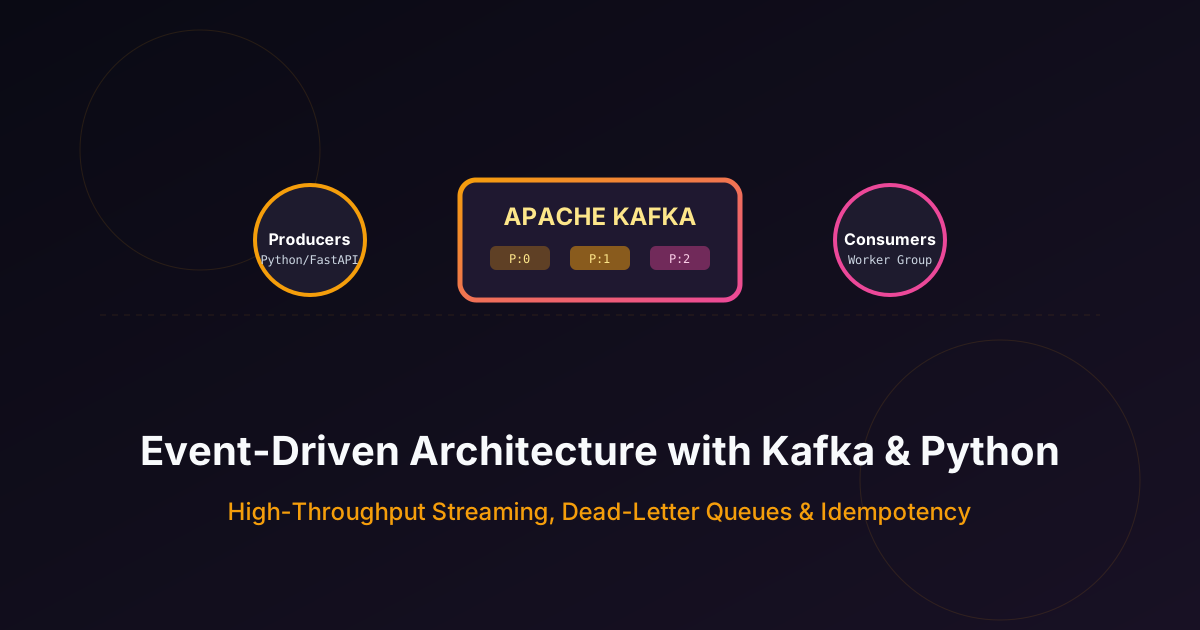
System DesignKafkaPythonMicroservicesBackend
Event-Driven Architecture with Apache Kafka & Python: Building Resilient Real-Time Systems
The Limitations of Synchronous REST APIs
When scaling microservices, the default instinct for most engineering teams is synchronous HTTP/gRPC communication: Service A calls Service B, which synchronously awaits Service C.
While straightforward, this approach quickly creates severe systemic vulnerabilities:
- Cascading Failures: If Service C experiences high latency or an outage, Service B runs out of connection pools, causing Service A to time out and bring down the entire checkout flow.
- Tight Coupling: Adding a new downstream capability (e.g., an AI fraud detection pipeline or a real-time notification engine) requires modifying the primary transaction handler.
- Traffic Spikes & Throttling: A surge of Black Friday purchases will overwhelm downstream analytics and email services.
To build genuinely fault-tolerant, horizontally scalable systems, modern architectures embrace Event-Driven Architecture (EDA) with Apache Kafka.
Core Kafka Primitives: The Distributed Commit Log
Unlike traditional message brokers (like RabbitMQ or AWS SQS) that delete messages once acknowledged, Kafka is an append-only, distributed commit log:
[Producer: Order Service]
           │
           ▼
[Kafka Cluster: Topic 'order-events']
 ├── Partition 0: [msg 0][msg 1][msg 2][msg 3] ──► Consumer Group 'billing' (reads offset 3)
 ├── Partition 1: [msg 0][msg 1][msg 2]        ──► Consumer Group 'inventory' (reads offset 2)
 └── Partition 2: [msg 0][msg 1][msg 2][msg 3] ──► Consumer Group 'notifications' (reads offset 1)
Key principles to remember:
- Topics & Partitions: A topic is categorized into partitions. Messages within a partition are strictly ordered by sequential offset.
- Partition Keys & Hashing: When publishing an event, you provide a partition key (e.g.,
user_idororder_id). Kafka hashes this key to ensure all events for that specific entity land on the exact same partition, guaranteeing chronological order. - Consumer Groups: Multiple instances of a service join a consumer group. Kafka automatically distributes topic partitions across members of the group. If an instance crashes, Kafka rebalances partitions seamlessly.
Hands-On: Building an Asynchronous Event Pipeline in Python
Let's build a production-grade producer and consumer pair using
confluent-kafka, the high-performance C-backed Python client for Apache Kafka.1. The High-Throughput, Idempotent Producer
In production, producers must handle network blips without creating duplicate records or losing events. We configure
enable.idempotence=true and explicit delivery callbacks:python# producer.py import json import logging from confluent_kafka import Producer logging.basicConfig(level=logging.INFO) logger = logging.getLogger(__name__) def delivery_report(err, msg): """Callback invoked on delivery confirmation or failure.""" if err is not None: logger.error(f"Event delivery failed for key {msg.key()}: {err}") else: logger.info( f"Event delivered to {msg.topic()} [partition {msg.partition()}] at offset {msg.offset()}" ) producer_config = { 'bootstrap.servers': 'localhost:9092', 'client.id': 'order-api-producer', 'acks': 'all', # Require acknowledgment from all in-sync replicas 'enable.idempotence': True, # Guarantees no duplicate deliveries on retry 'retries': 5, 'max.in.flight.requests.per.connection': 5, 'compression.type': 'snappy', # Reduce network bandwidth by ~40-60% 'linger.ms': 20, # Batch events over 20ms for higher throughput } producer = Producer(producer_config) def publish_order_event(order_data: dict): key = str(order_data['customer_id']).encode('utf-8') payload = json.dumps(order_data).encode('utf-8') # Asynchronous produce (non-blocking) producer.produce( topic='production.orders.v1', key=key, value=payload, on_delivery=delivery_report ) # Serve delivery report callbacks from previous produce requests producer.poll(0) # Example usage publish_order_event({ "order_id": "ord_98765", "customer_id": "cust_4321", "amount": 149.99, "currency": "USD", "status": "CREATED", "timestamp": 1793448000 }) # Flush remaining messages before shutdown producer.flush(timeout=5)
2. The Resilient Consumer with Dead-Letter Queuing (DLQ)
A consumer must never crash indefinitely on "poison pill" messages (e.g., malformed payloads). Here is a robust consumer implementing manual offset commits and Dead-Letter Queue routing:
python# consumer.py
import json
import logging
from confluent_kafka import Consumer, KafkaError, Producer

logging.basicConfig(level=logging.INFO)
logger = logging.getLogger(__name__)

consumer_config = {
    'bootstrap.servers': 'localhost:9092',
    'group.id': 'billing-processor-group',
    'auto.offset.reset': 'earliest',
    'enable.auto.commit': False,    # Explicit manual commit prevents data loss
    'max.poll.interval.ms': 300000, # 5 minutes max processing time per batch
}

consumer = Consumer(consumer_config)
consumer.subscribe(['production.orders.v1'])

dlq_producer = Producer({'bootstrap.servers': 'localhost:9092'})

def route_to_dlq(raw_message, reason: str):
    """Publish malformed or unprocessable event to Dead-Letter Queue for inspection."""
    logger.warning(f"Routing to DLQ: {reason}")
    dlq_producer.produce(
        topic='production.orders.dlq',
        key=raw_message.key(),
        value=raw_message.value(),
        headers=[('error_reason', reason.encode('utf-8'))]
    )
    dlq_producer.poll(0)

def process_order(event: dict):
    # Idempotent database transaction logic goes here
    logger.info(f"Processing order: {event['order_id']} for customer {event['customer_id']}")

def run_consumer_loop():
    try:
        while True:
            msg = consumer.poll(timeout=1.0)
            if msg is None:
                continue

            if msg.error():
                if msg.error().code() == KafkaError._PARTITION_EOF:
                    continue
                else:
                    logger.error(f"Kafka consumer error: {msg.error()}")
                    break

            try:
                # 1. Parse JSON payload
                data = json.loads(msg.value().decode('utf-8'))

                # 2. Process business logic
                process_order(data)

                # 3. Commit offset only upon successful processing
                consumer.commit(message=msg, asynchronous=False)

            except json.JSONDecodeError as err:
                route_to_dlq(msg, f"Invalid JSON: {err}")
                consumer.commit(message=msg, asynchronous=False)
            except Exception as exc:
                logger.error(f"Failed to process message offset {msg.offset()}: {exc}")
                # For transient failures, you could retry or route to retry topic

    finally:
        consumer.close()

if __name__ == "__main__":
    run_consumer_loop()
Production Patterns & Architecture Best Practices
When deploying Kafka in mission-critical environments, adopt these golden rules:
-
Partition Count Planning:
- The number of partitions in a topic represents the maximum theoretical concurrency of a single consumer group. If a topic has 6 partitions, running 12 consumer pods means 6 pods will sit completely idle. Size your partitions based on planned peak volume.
-
Schema Registry & Evolution:
- Never pass unvalidated arbitrary JSON in large engineering teams. Use Apache Avro or Protocol Buffers (Protobuf) backed by Confluent Schema Registry. This enforces strict backwards/forwards schema compatibility contracts between teams.
-
Lag Monitoring:
- Track Consumer Lag (the delta between the latest log offset and the consumer's current committed offset) using Prometheus and Grafana. Spiking lag is your primary indicator that downstream services require autoscaling.
By decoupling components into asynchronous event streams, your system transitions from fragile synchronous request chains to a robust, elastic architecture capable of handling millions of events without breaking a sweat.