AILLMOllamaMachine LearningPrivacyArchitecture
Local LLMs vs Cloud APIs: Running AI on Your Own Hardware in 2026
The Architectural Dilemma of Modern AI
As artificial intelligence integrations become a standard requirement in almost all modern software applications, engineering teams are facing a critical architectural crossroad: Should we rely entirely on powerful, proprietary cloud APIs (like OpenAI's GPT-4, Anthropic's Claude, or Google's Gemini), or should we self-host open-weight models locally on our own infrastructure?
This decision impacts everything from the application's operating costs and latency to its data privacy compliance and long-term viability. In this guide, we will break down the pros and cons of each approach and explore the hybrid architectures that are dominating in 2026.
The Case for Cloud APIs
Cloud APIs are usually the default starting point for any AI integration, and for good reason. They offer unparalleled convenience and access to the absolute bleeding edge of machine learning reasoning capabilities.
Advantages of Cloud Models
- Zero Infrastructure Overhead: There is no need to procure expensive GPUs, manage CUDA drivers, configure load balancers for inference, or handle complex model updates. You simply make a REST API call.
- State-of-the-Art Intelligence: Cloud models are typically magnitudes larger than what can run on consumer or standard enterprise hardware. They excel at highly complex, multi-step reasoning tasks, creative writing, and understanding nuanced contexts.
- Speed to Market: A developer can integrate OpenAI into a Next.js or FastAPI app in less than an hour using official SDKs.
The Drawbacks of the Cloud
- Cost at Scale: While cheap for prototyping, paying per-token (or per-million tokens) becomes exorbitantly expensive for high-traffic applications. If your app summarizes thousands of documents daily, the API bills will skyrocket.
- Data Privacy and Security: Sending sensitive user information, proprietary corporate code, or protected health information (PHI) to a third-party API is a massive security risk. Many enterprise and government clients strictly prohibit this.
- Vendor Lock-in and Deprecation: Relying on a specific cloud provider means your application's behavior might change unexpectedly when they update their models, or break entirely if a model is deprecated.
The Rise of Local and Open-Weight LLMs
Over the past few years, the open-source AI community has made staggering progress. Models like Meta's Llama 3, Mistral, and Qwen are incredibly capable and, thanks to quantization techniques, can run on relatively modest hardware—sometimes even on standard MacBooks or low-tier AWS EC2 instances.
Tools Making Local AI Easy
Historically, running AI models required a deep understanding of PyTorch, Hugging Face transformers, and complex Python environments. Today, the tooling has caught up:
- Ollama: Ollama is the Docker of local LLMs. It provides a simple command-line interface to pull and run models on macOS, Linux, and Windows. Crucially, it spins up a local server that mimics the OpenAI API schema, meaning you can often switch from cloud to local by simply changing the base URL in your code.
- vLLM: While Ollama is great for local development, vLLM is designed for production. It is a high-throughput and memory-efficient inference engine that can serve thousands of requests per second using techniques like PagedAttention.
Why Go Local?
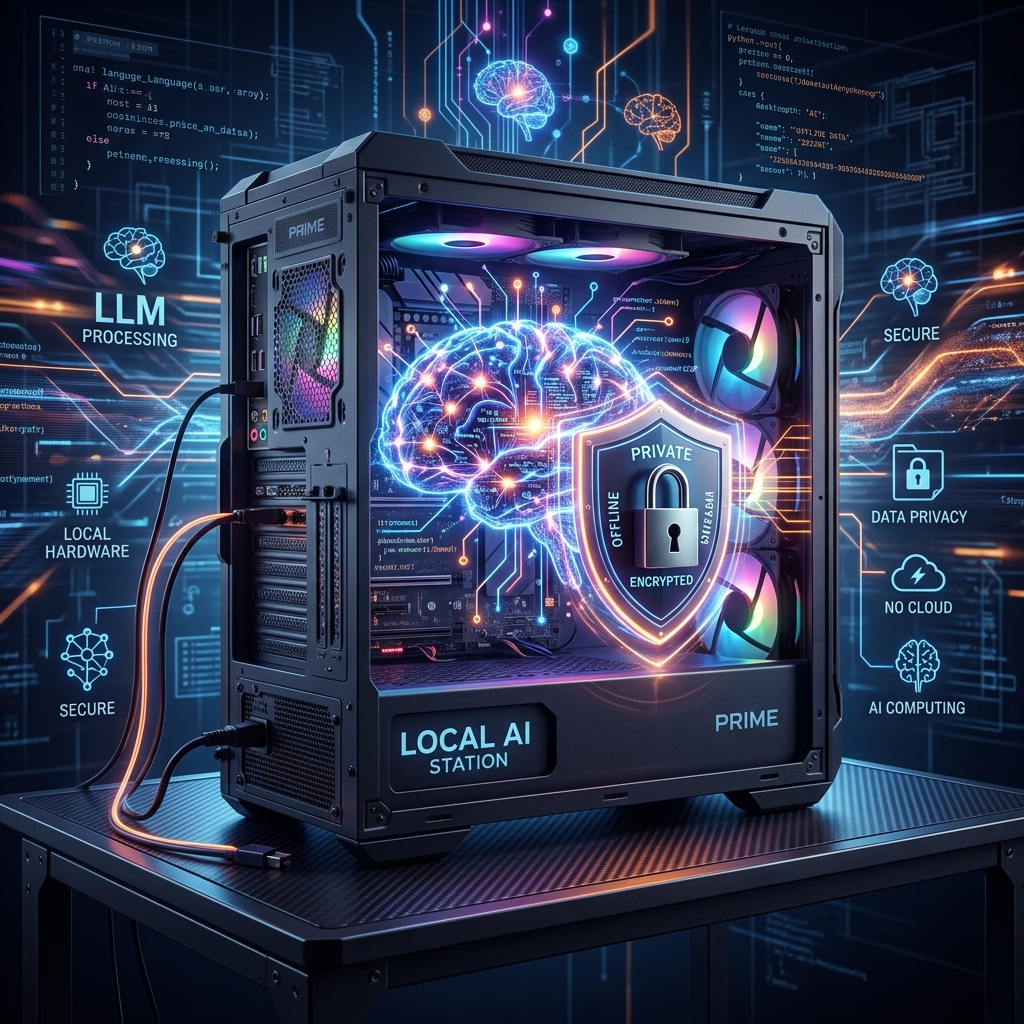
- Total Data Privacy: When you run a model in your own VPC (Virtual Private Cloud) or on bare metal, the data never leaves your infrastructure. This is the only acceptable architecture for HIPAA compliance or handling proprietary enterprise data.
- Predictable, Fixed Costs: With local models, you pay for the compute (hardware or cloud instances), not per token. If you own the hardware, running inference 24/7 costs nothing but electricity. For sustained, high-volume tasks, local models are vastly cheaper.
- Control and Customization: You have complete control over the model's behavior. You can fine-tune it on your specific company data without worrying about a cloud provider analyzing your proprietary information.
The Optimal Solution: Hybrid Routing Architectures
In 2026, the most effective and cost-efficient architecture is not choosing one over the other, but using a Hybrid Router Pattern.
How Routing Works
Not every AI task requires the massive reasoning power of GPT-4.
- If your application needs to extract a date from a string, format a JSON object, or perform basic sentiment analysis, a small, fast local model (like Llama 3 8B) running via Ollama is more than capable. It will do the job for free and with zero privacy risks.
- If the user asks a highly complex question that requires deep logical reasoning or writing complex code, the application "routes" that specific request to the expensive Cloud API.
Tools like LangChain and LlamaIndex now have built-in routing mechanisms that intelligently decide which model to query based on the complexity of the prompt.
Conclusion
The era of defaulting to expensive cloud APIs for every AI task is ending. As open-weight models become smarter and inference engines become more optimized, running LLMs locally is becoming a standard engineering practice. By implementing hybrid architectures, developers can achieve the perfect balance of state-of-the-art intelligence, data privacy, and cost-efficiency.