RustPythonJavaScriptPerformanceWeb Development
Rust for Web Developers: Why Python and JS Devs are Learning Rust in 2026
The Unstoppable Rise of Rust
For nearly a decade, Rust has consistently ranked as the "most loved" programming language in the annual Stack Overflow developer surveys. Historically, Rust was viewed purely as a systems programming language—a safer alternative to C and C++ for writing operating systems, game engines, and embedded software.
However, over the last few years, Rust has aggressively expanded its territory. It has moved from a niche systems language to a foundational pillar of modern web development. As a Python or JavaScript developer, you might be wondering: Why is everyone talking about Rust, and should I learn it?
The Tooling Revolution: Rust Under the Hood
The most immediate and profound impact of Rust on web developers isn't that they are suddenly writing entire backend APIs in Rust (though frameworks like Axum are popular). Instead, the impact is felt because the tools they rely on every day are being rewritten in Rust.
Transforming the JavaScript Ecosystem
The JavaScript ecosystem has always struggled with performance, especially in build tools. Enter Rust:
- SWC (Speedy Web Compiler): SWC is a super-fast TypeScript/JavaScript compiler written in Rust. It has largely replaced Babel in modern toolchains (like Next.js) because it is up to 20x faster.
- Turbopack: Created by the creator of Webpack, Turbopack is an incremental bundler written in Rust, designed to be the ultra-fast successor to Webpack.
- Runtimes (Deno & Bun): While Node.js is built on C++, the next generation of JS runtimes heavily leverage modern systems languages. Deno is built largely with Rust, and Bun (written in Zig) shares the same philosophy of pushing performance boundaries.
Revolutionizing Python
The Python ecosystem, known for its elegant syntax but slow execution speed, is experiencing a similar Rust-driven renaissance.
- Ruff: An incredibly fast Python linter and formatter written in Rust. It is so fast (orders of magnitude faster than Flake8, Black, or isort) that it has become the standard in almost all modern Python projects.
- Pydantic (pydantic-core): Pydantic is the core validation library underlying FastAPI. In version 2, its core validation logic was rewritten in Rust (
pydantic-core), resulting in massive speedups (up to 50x) for data validation and serialization. - Polars: A DataFrame library meant to replace Pandas, written entirely in Rust. It is blazing fast and handles multithreading effortlessly, solving one of Python's biggest data science pain points.
Why Learn Rust as a High-Level Developer?
If the tools are just getting faster automatically, why should a React or Django developer bother learning the language itself?
1. Building High-Performance Extensions
Python and Node.js are excellent for developer velocity, but they inevitably hit CPU bottlenecks. When a specific algorithm in your Django app is too slow, rewriting the entire app in Go or Java is a massive undertaking.
With tools like PyO3 (for Python) or NAPI-RS (for Node), it is incredibly easy to write just that one performance-critical function in Rust, compile it to a native module, and call it directly from your high-level code. You get the speed of C with the safety of Rust, seamlessly integrated into your existing app.
2. WebAssembly (Wasm)
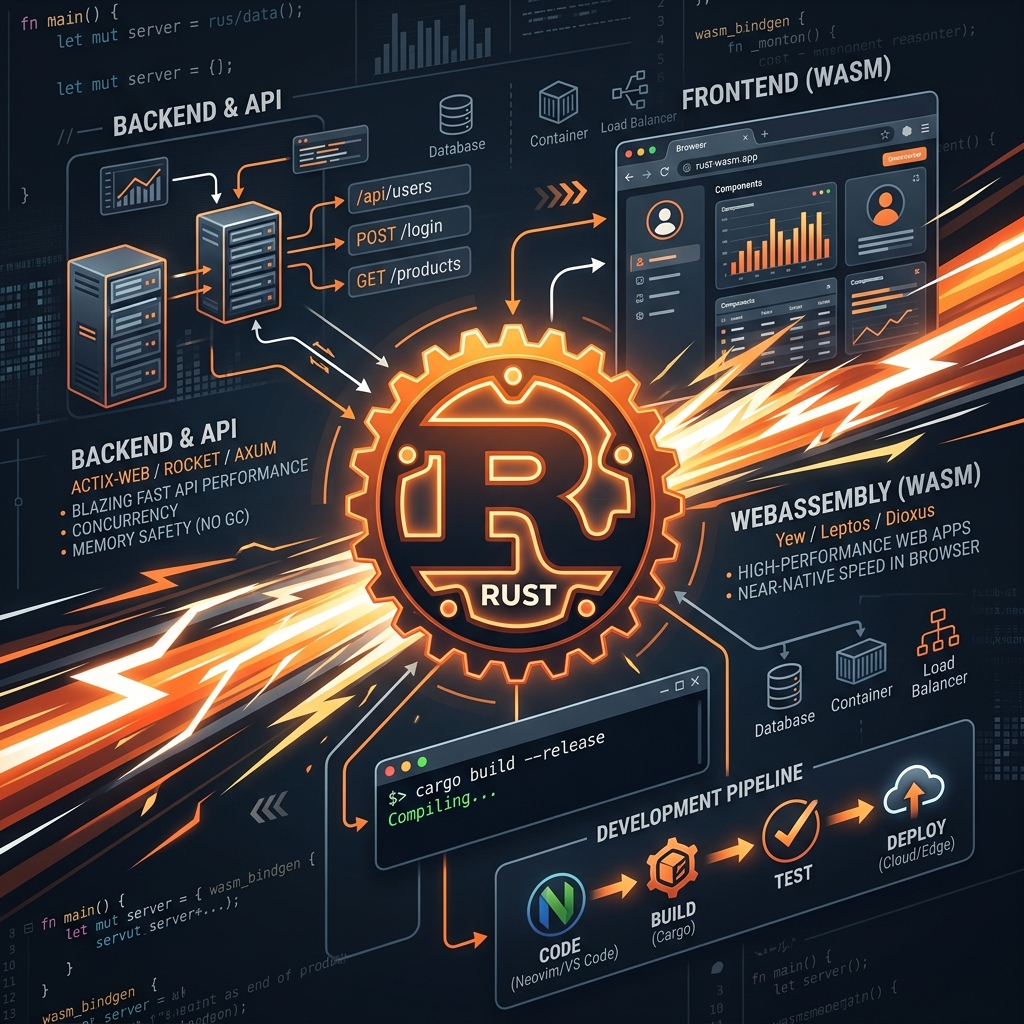
As WebAssembly becomes the standard for running high-performance code in the browser, Rust is universally recognized as the premier language for targeting Wasm. Rust's lack of a garbage collector means it compiles to tiny, fast Wasm modules. If you want to build a browser-based video editor, an interactive 3D application, or run complex cryptography on the client, Rust is the tool for the job.
3. Upgrading Your Mental Models
Perhaps the most valuable reason to learn Rust is how it changes the way you think about programming.
Languages like Python and JavaScript hide memory management from you. Rust's infamous "Borrow Checker" forces you to think deeply about data ownership, mutability, and concurrency.
Learning how Rust prevents data races at compile-time will make you a much better, more defensive programmer. When you return to Python or JS, you will naturally write safer, more predictable code because your mental model of how memory works has evolved.
Getting Started
Rust has a notoriously steep learning curve. The compiler is strict and will refuse to compile code that would easily run (and potentially crash) in Python.
The best approach is to start small. Don't try to build a full web server immediately. Instead:
- Read the official "Rust Book" (The Rust Programming Language)—it is universally praised as one of the best technical guides ever written.
- Take a small, computationally heavy script you've written in Python or Node.js.
- Rewrite it in Rust and compare the performance.
Embrace the compiler errors; in Rust, the compiler is not your enemy, it is an extremely strict mentor guiding you toward writing indestructible code.