ReactNext.jsFrontendJavaScriptPerformance
Mastering React Server Components in 2026
React Server Components (RSC) represent the most profound architectural shift in the React ecosystem since the introduction of Hooks in 2018. While initially met with skepticism and confusion, RSCs have now matured into the standard methodology for building highly performant, data-driven web applications in frameworks like Next.js.
If you are still writing traditional Single Page Applications (SPAs) burdened with endless
useEffect data fetching loops and massive loading spinners, this comprehensive guide will help you understand why Server Components are the definitive future of frontend engineering.The Problem with Traditional React
To understand why React Server Components exist, we must first look at the flaws of traditional Client-Side Rendering (CSR).
Historically, React components ran entirely on the client (the user's browser). The typical lifecycle looked like this:
- The user requests a page. The server sends a blank HTML file containing a
<div id="root"></div>and a massive JavaScript bundle. - The user stares at a blank white screen while their browser downloads, parses, and executes megabytes of JavaScript.
- The React application mounts and renders a Loading Spinner.
- The component fires a
useEffecthook to fetch data from an external REST API. - The API queries the database, formats the JSON, and sends it back to the client.
- The React component finally re-renders with the actual data.
This approach creates a terrible user experience (network waterfalls), ruins SEO (crawlers see a blank page), and forces mobile devices to waste battery power parsing giant JavaScript bundles just to render static text.
Enter React Server Components
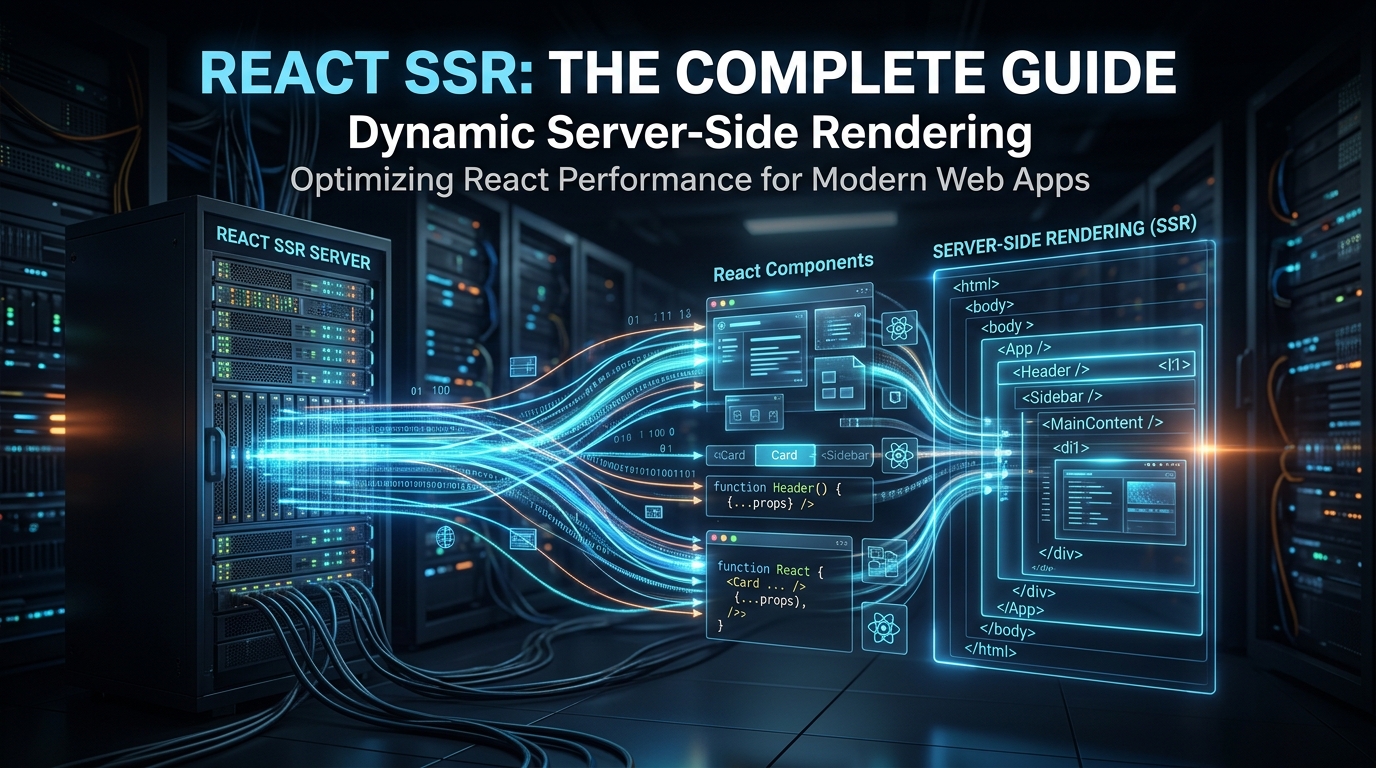
React Server Components run exclusively on the server.
They never ship to the client. The server executes the component, fetches the necessary data directly from your backend resources, and streams the resulting HTML and a special serialized RSC payload down to the browser. The browser simply takes this payload and paints it to the screen.
Client Components vs Server Components
The React ecosystem is now split into two paradigms that work seamlessly together:
- Server Components (The Default): Best used for fetching data directly from a database, accessing backend resources (like file systems or microservices), keeping large dependencies (like markdown parsers) on the server, and improving Initial Page Load times.
- Client Components (The
"use client"directive): Required whenever a component needs interactivity (onClick,onChange), state management (useState,useReducer), lifecycle effects (useEffect), or access to browser-only APIs (window,localStorage,geolocation).
The Data Fetching Revolution
The most immediate and obvious benefit of RSCs is how radically it simplifies data fetching.
Before RSCs, you had to build an entire API route layer just to serve data to your frontend components.
jsx// The Old Way (Client-Side Fetching with API Routes)
import { useEffect, useState } from 'react';
import { Spinner } from './components';

export default function UserProfile({ userId }) {
  const [user, setUser] = useState(null);
  const [loading, setLoading] = useState(true);

  useEffect(() => {
    // Requires a separate Express/Next.js API route to be built
    fetch(`/api/users/${userId}`)
      .then(res => res.json())
      .then(data => {
        setUser(data);
        setLoading(false);
      });
  }, [userId]);

  if (loading) return <Spinner />;
  return <div>Welcome back, {user.name}</div>;
}
With React Server Components, you can eliminate the API layer entirely. Because the component executes on the server, you can securely query your database directly inside the component using
async/await.jsx// The New Way (Server Component) import db from '@/lib/database'; // Prisma, Drizzle, etc. // Notice the 'async' keyword! export default async function UserProfile({ userId }) { // Fetch directly from the DB. No API route needed. // This query runs securely on your backend. const user = await db.user.findUnique({ where: { id: userId } }); return <div>Welcome back, {user.name}</div>; }
This code is incredibly readable, inherently type-safe, and infinitely faster because there is no network latency between the component and the API.
Security Implications and Best Practices
Because Server Components run in a Node.js backend environment, you can safely use database credentials, API keys, and secret tokens directly inside the component without fear of exposing them to the client.
However, you must be extremely cautious about the boundaries between Server and Client components.
The Golden Rule of RSCs: Any prop passed from a Server Component down to a Client Component is serialized into JSON and sent over the public internet to the user's browser.
If you query a user object from your database in a Server Component, and pass that entire object to a Client Component, you just sent the user's hashed password and internal metadata to the browser's network tab.
jsx// DANGEROUS PATTERN
export default async function ProfilePage() {
  const user = await db.user.findFirst();

  // DANGER: We are sending the entire user object (including secrets) to the client!
  return <InteractiveProfileForm user={user} />
}

// SAFE PATTERN
export default async function ProfilePage() {
  const user = await db.user.findFirst();

  // SAFE: We explicitly select only the public fields needed by the client.
  const safeUserData = { id: user.id, name: user.name, avatar: user.avatar };

  return <InteractiveProfileForm user={safeUserData} />
}
Streaming and Suspense Architecture
One of the most powerful features unlocked by the server-side nature of RSCs is Streaming.
Imagine a dashboard page that has a fast header, a fast sidebar, but a very slow
RevenueChart component that takes 3 seconds to query the database. In a traditional SSR app, the user would wait 3 seconds to see anything at all.With React
<Suspense>, you can wrap the slow component in a boundary. React will immediately send the HTML for the header and sidebar to the browser, display a fallback UI for the chart, and seamlessly stream the chart data in via HTTP chunked transfer encoding once the server finishes resolving it.jsximport { Suspense } from 'react'; import Header from './Header'; import Sidebar from './Sidebar'; import RevenueChart from './RevenueChart'; // Slow Server Component import ChartSkeleton from './ChartSkeleton'; export default function Dashboard() { return ( <div className="layout"> <Header /> <Sidebar /> <main> {/* The rest of the page loads instantly. The chart streams in later! */} <Suspense fallback={<ChartSkeleton />}> <RevenueChart /> </Suspense> </main> </div> ); }
Conclusion
React Server Components allow frontend developers to write code that feels like traditional backend templating (like PHP, Ruby on Rails, or Django), but with all the composability, interactive power, and massive ecosystem of modern React.
By keeping heavy dependencies and complex data fetching exclusively on the server, we can build significantly faster, more secure, and highly scalable applications for our users. Embrace the server!